


Where asset allocation determines where you invest, manager research determines how you invest. The strongest portfolios don’t rely on a single investment view; they combine multiple specialist perspectives to build more resilient outcomes. Diversification doesn’t stop at asset classes – it should extend to investment thinking.
Successful investing is often described as an asset allocation exercise. When investors think about diversification of asset allocation, they usually think in terms of asset classes –
- How much should I invest in equities, bonds, property or cash?
- How much should I allocate to offshore assets?
- How much should I allocate to local equities?
These are important decisions because asset allocation remains one of the primary drivers of long-term portfolio outcomes. But asset allocation is only the beginning. Once those decisions have been made, an equally important question remains: How should those investment views be implemented?
True diversification occurs at multiple levels
Two portfolios can have identical asset allocations yet produce meaningfully different risk/return outcomes depending on the managers selected to express those views. The difference lies in investment philosophy, portfolio construction, stock selection and implementation. In other words, asset allocation determines where capital is invested, while manager selection determines how those investment decisions are executed.
Various layers of diversification exist, for example:
- The first layer is diversification across asset classes (strategic asset allocation) such as equities, bonds, property and cash.
- The second layer is tactical asset allocation, adjusting these exposures as market conditions evolve.
- The third, and often overlooked, layer is diversification across investment styles, philosophies and managers.
Even at just the first layer, category leaders rotate constantly and rarely in a predictable way, as the table below illustrates.
Exhibit 1 | Asset class returns

Source: Morningstar. Data as at 30 June 2026. Returns longer than one year annualised. MSCI World (Global Equities), FTSE WGBI (Global Bonds), Beassa ALBI (Bonds), USD/ZAR (US$), FTSE/JSE All Share (SA Equities). Past performance is not indicative of future performance. For illustrative purposes only and not indicative of any investment.
While this is not an exhaustive list, these three layers illustrate the progression from deciding where to invest to determining how those decisions are implemented. Additional layers of diversification can also be incorporated, including geographic diversification, securities diversification, factor exposures (such as value, quality and momentum), and portfolio risk management. By combining managers with different styles, strengths and investment philosophies, portfolios become diversified not only across asset classes, but also across investment thinking.
As Exhibit 1 illustrates, markets and return drivers rotate, and therefore, no manager will be correct all the time. Different investment styles outperform under different market conditions. By blending complementary managers, investors create portfolios that are designed to perform more consistently across changing market environments rather than relying on one manager to get every call right.
The question we believe deserves more attention is “How should you express those investment views?” This is where manager research becomes one of the most valuable components of the investment process.
What’s under the hood?
At first glance, two cars may appear remarkably similar. It’s only when you look under the bonnet that the real differences become apparent. The engine, engineering and design determine how each vehicle performs. Investment portfolios are much the same. Two portfolios may share the same asset allocation, but what sits beneath the surface (the managers, investment philosophy and portfolio construction) can lead to markedly different investment outcomes.
Four investment portfolios that all allocate 40% to South African equities would appear almost identical at first glance. In reality, and as can be seen below, they could look completely different. For example:
- One manager may favour resource companies, believing commodity prices are entering a new cycle.
- Another may prefer domestic financials, expecting lower interest rates and improving consumer confidence.
- A third may focus on quality growth businesses with strong balance sheets
- Another sees greater opportunity in smaller and mid-cap companies.
The asset allocation is identical. The investment outcome may not be.
Exhibit 2 | Example of sector composition by different managers
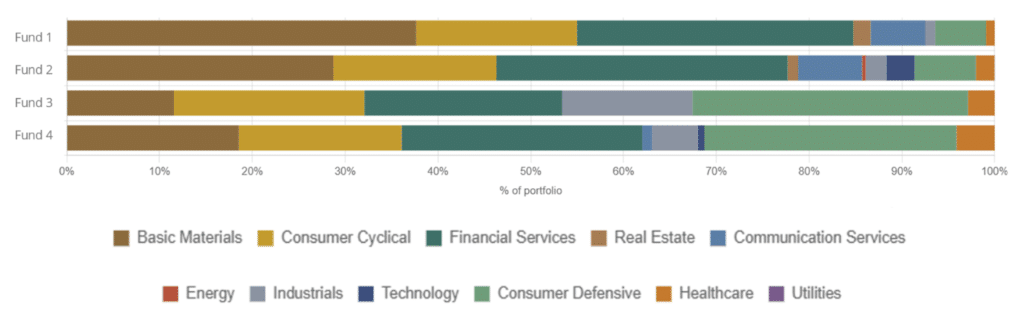
Source: Morningstar. Data as at 30 June 2026. Past performance is not indicative of future performance. For illustrative purposes only and not indicative of any investment.
Each of the latter four funds expresses that same 40% local equity exposure in very different ways. For example:
- One simply tracks the index, taking no active view at all.
- Another is discretionary and style-agnostic, building a diversified spread across cyclical, quality, value and growth exposures, and expressing its views mainly through stock selection and sector positioning rather than large asset-allocation shifts.
- A third takes a systematic, quantitative route, blending value, quality and growth factors through a rules-based model rather than a house view.
- Another manager takes yet another route: a concentrated, high-conviction, long-term value approach, backing a small number of businesses it is comfortable holding for five to ten years or longer.
Again, we see the same 40% allocation, four very different portfolios and, as the chart below shows, four very different return paths over time.
Exhibit 3 | South African Equity Funds: Rolling returns (annualised)
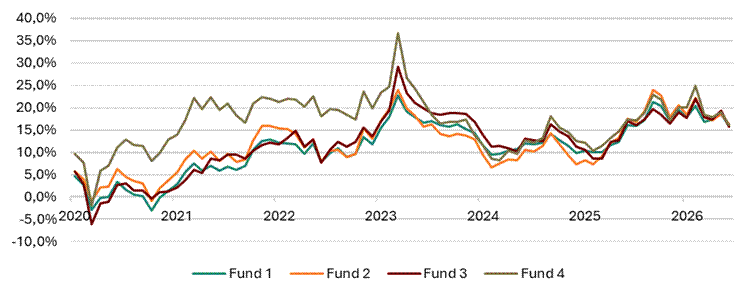
Source: Morningstar. Data as at 30 June 2026. Past performance is not indicative of future performance. For illustrative purposes only and not indicative of any investment.
This highlights an important distinction: Asset allocation determines where to invest. Manager selection determines how to invest.
Tactical implementation matters
Markets evolve continuously. A positive view on local equities today does not necessarily require the same implementation as six months ago. For example, if opportunities emerge within the resources sector, allocations can be tilted towards managers with proven expertise in that area. If domestic economic conditions improve, portfolios may increase exposure to managers with greater mid-cap or domestic cyclical holdings. If uncertainty rises, quality-focused managers may become more appropriate.
These are tactical implementation decisions that sit below the headline asset allocation. They are often the difference between simply participating in markets and positioning portfolios to take advantage of changing opportunities.
The DFM advantage
Many investors unknowingly place significant reliance on a single investment team’s philosophy. Whether investing with one active manager or simply tracking an index, the portfolio is ultimately driven by one approach to investing. A discretionary fund manager (DFM) has the opportunity to think differently.
Rather than relying on a single investment philosophy, portfolios can combine multiple specialist managers with complementary strengths. If the investment committee believes South African equities offer attractive opportunities, the conversation doesn’t end there. Instead, it begins by investigating this reasoning.
- Should that view be expressed through a manager with greater exposure to resources?
- Should we increase exposure to managers focused on mid-cap opportunities?
- Would a quality-growth manager be better positioned if economic conditions remain uncertain?
- Or should the allocation be spread across several managers, each bringing a different perspective?
The objective isn’t simply to own South African equities. It’s to own them in the most effective way possible.
Why this matters for Financial Advisers?
For financial advisers, this is where a DFM adds meaningful value. Manager research is far more than identifying the “best” fund managers or selecting last year’s top performers. It is an ongoing, specialist discipline that requires continuous due diligence, qualitative assessment, portfolio analysis and an understanding of how different managers are likely to perform across varying market environments.
A DFM’s role is to look beyond individual funds and consider how managers complement one another within a portfolio. This includes evaluating investment philosophy, portfolio construction, risk management, team stability, capacity constraints and style biases, while continually assessing whether each manager remains the most appropriate way to express a particular investment view.
This enables advisers to focus on what they do best – building trusted client relationships and delivering holistic financial advice – while relying on an experienced investment partner to undertake the complex and resource-intensive work of manager research, portfolio construction and ongoing tactical implementation.
The objective is not to find a single perfect manager. It is to build resilient portfolios by combining complementary investment managers whose different perspectives and strengths work together to deliver more consistent outcomes over time.
In closing
Today’s investment landscape is increasingly complex. Markets are influenced by shifting interest rates, geopolitics, technological disruption and changing economic cycles. In this environment, diversification should extend beyond the assets investors own to the investment decisions that shape those portfolios.
At OIG, we believe our value lies not only in determining the appropriate asset allocation, but in carefully selecting and combining managers with different investment philosophies and strengths to express those views.
Because successful investing isn’t only about deciding where to invest. It’s about deciding how to invest.

