

Monthly macro and economic insights report
Our monthly To the Point column by economist Dr Roelof Botha offers in-depth analysis and commentary on the latest economic trends, market developments, and financial news. Designed to keep you informed and ahead of the curve, each edition delves into key economic indicators, explores their impact on global and local markets, and provides insights to help you navigate the ever-changing economic landscape
Rand resilience continues
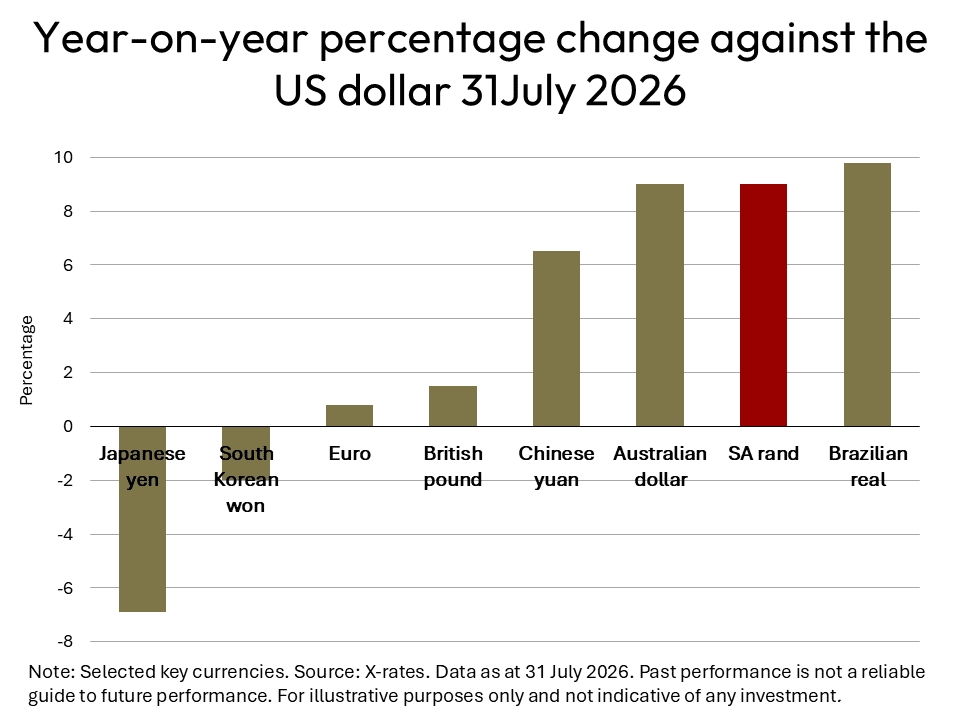
Over the past twelve months, South Africa’s currency has continued its upward momentum against the US dollar and has also remained exceptionally stable against most other key currencies. Although the rand retreated marginally against the greenback in July, its year-on-year performance has been stellar, with only the Brazilian real recording a larger gain[1].
The rand’s solid performance over the past twelve months is underscored by the US dollar index (also referred to as the ‘Dixie’) increasing marginally by 18 basis points during the past year. As a rule of thumb, a stronger US dollar places pressure on most other currencies, due to, inter alia, its dominant position in global foreign exchange markets and the prominent role of US bonds in central bank foreign exchange reserves.
One of the main reasons for the strength of the rand can be seen in the fundamental economic theory. A country that attracts a surplus of foreign exchange on its balance of payments will tend to experience currency strength, especially in the case of a consistent surplus on both the current and financial accounts of the balance of payments. This has been the case in South Africa over the past two years, with the surge in the values of mineral exports improving fiscal stability.
Although exporters can be forgiven for not celebrating the impressive performance of the rand, it has certainly played its part in keeping the rand-denominated prices of imports in check, thereby assisting the quest for lower inflation and, hopefully soon, a resumption of the rate-cutting cycle by the South African Reserve Bank.
Inflation – some respite ahead
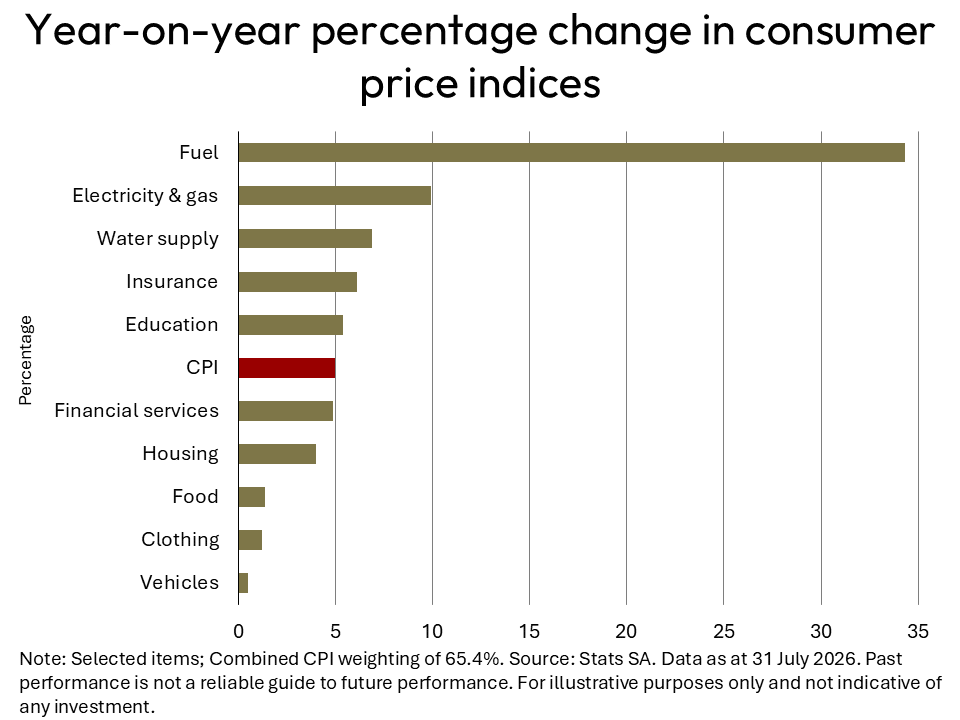
As expected, the lingering negative impact of higher fuel prices has moved the consumer price index (CPI) to its highest level in two years. A mere three months ago, consumer inflation was 3.1% but climbed to 5% in June. When analysing the price trends for the different consumer items included in the CPI, it is abundantly clear that fuel and administered prices are the main culprits in the current upward trend.
In June, a year-on-year increase of 34.3% was recorded for the fuel price index, whilst the annualised increase in the cost of electricity continues to hover at a double-digit rate. Neither of these increases is related to excess demand in the economy, but to external factors associated with the demise of Eskom’s operational efficiency during the state capture era and the war in Iran, which has led to a spike in oil prices
Fortunately, hostilities in the Middle East are bound to ease eventually, which will inevitably lead to a resumption of adequate oil and fuel supplies and, as a result, a sharp lowering of fuel prices. With an ever-increasing share of South Africa’s electricity supply coming from solar and wind power (accompanied by declining prices for supporting equipment), the cost of electricity may also be on a downward trend.
One of the most encouraging features of the latest CPI data is the declining trend of food prices, which is the dominant expenditure category for lower-income groups. Since the end of 2024, food inflation has declined consistently to a level of only 1.4%. The prospect of an imminent reversal of the CPI trend has played its part in the decision of the monetary authorities to keep the benchmark prime lending rate at 10.5%, which is good news for millions of South Africans with mortgage bonds and other debt.
Surge in mineral sales
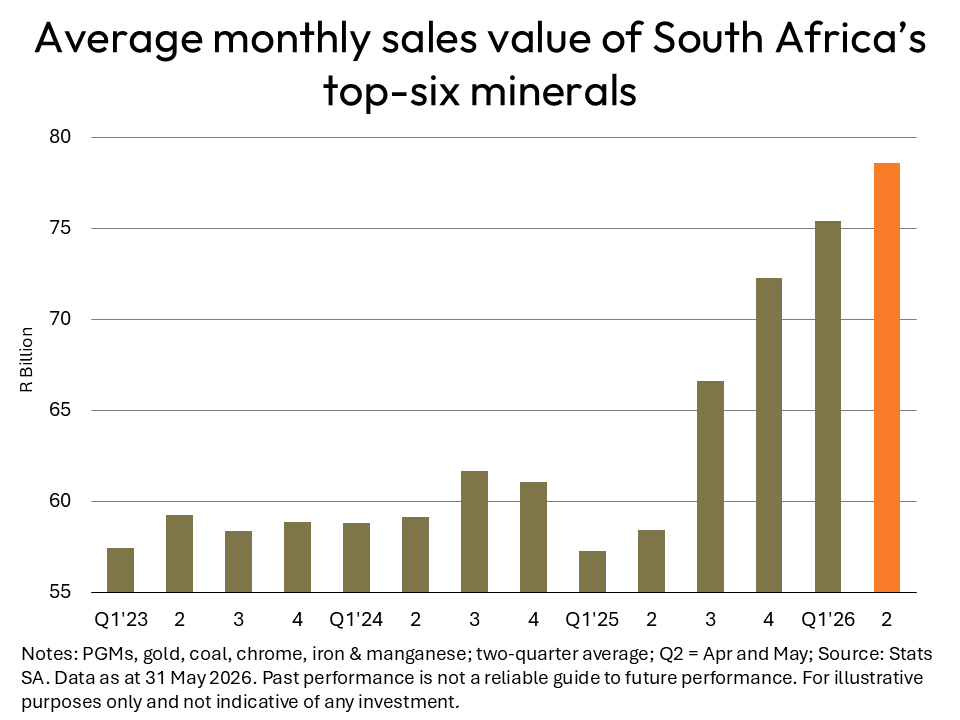
South Africa’s mining sector has enjoyed a spectacular start to 2026. The upward momentum of mineral sales values reached an all-time high in April and May (based on average monthly values).
Although the prices of gold and platinum have declined since the flare-up of hostilities in the Middle East, the rising trend of sales values that kicked in during 2025 has provided the National Treasury with a welcome bonus. This comes in the form of higher company tax revenues, which assisted fiscal stability via a third successive primary budget surplus. This achievement has played a part in the recent upgrades of the outlook for South Africa’s sovereign bonds by all three global credit rating agencies.
The recent performance of gold has been particularly impressive. Between the first quarter of 2023 and the first quarter of 2025, the value of coal sales was 55% higher (on average) than that of gold. The tables have now been turned, with gold sales outperforming coal sales by 21% (on average) since the fourth quarter of last year.
A stronger US dollar represents one of the reasons for the recent decline in the gold price, which is also due to profit-taking by investors who bought gold at pre-2025 prices. Another reason is related to the increase in US Treasury yields, which has increased the opportunity cost of holding non-yielding assets such as gold.
Solar power gaining ground
South Africa has joined an exclusive club of 28 countries that possess more than 10GW of solar photovoltaic (PV) energy capacity, with sustained growth in new installations. According to the International Energy Agency (IEA), South Africa had a cumulative installed PV capacity of 12 GW at the end of 2025.
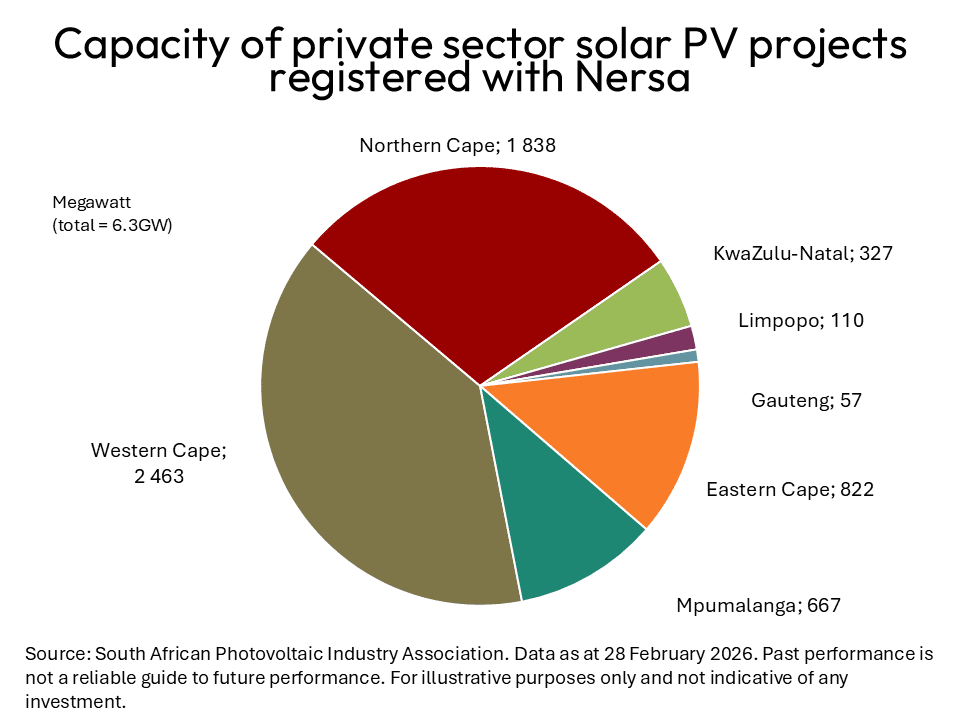
Data published by the South African Photovoltaic Industry Association (SAPVIA) shows that the country’s total registered solar power capacity has continued to expand at a healthy rate, reaching a total of 13,388 by the first quarter of 2026. This figure excludes PV installations that are combined with wind turbines and battery energy storage systems.
Although other sources of renewable energy are also playing an important role in the global quest for lower fossil fuel dependence, it has become clear that solar PV has become the main engine of renewable capacity growth. Energy experts from various countries have indicated that the world is entering a new phase of solar energy deployment, with the manufacturing capacity of equipment continuing to exceed demand, placing pressure on the profitability of manufacturers. Another key constraint that South Africa is also facing is in the area of grid availability and access.
Global annual PV capacity has nevertheless risen by 188% since 2022 to a level of 700GW and a cumulative total installed capacity of just below 3TW. According to global energy experts, an annual expansion of 1TW is the scale required to fully mobilise equipment manufacturing capacity. This landmark may be reached in 2026.
[1] Source: Based on an analysis of the 16 key currencies monitored by Exchange4free


