


Artificial Intelligence (AI) is making financial information dramatically more accessible. AI assistants (such as Claude, ChatGPT and Copilot) are fast becoming a popular source of financial information and guidance. These “assistants” are at your fingertips; there are no lengthy wait times for meetings or feedback; all questions are welcome; they don’t sleep or take time off; and fees are relatively low. You can even go as far as personalising its tone of voice, teaching it who you are and how you like to be interacted with.
An increasing number of financial advisers are facing clients who have either asked all their questions to AI assistants in advance, or clients are asking their AI assistants on the spot – fact-checking or even second-guessing – as the advice is given. Furthermore, aspiring amateur and/or “DIY” investors, who are not using a paid-for professional financial adviser (either out of preference or lack of resources), are turning to Generative Engine Optimisation (GEO) to search for financial advice or even stock trading tips.
A double-edged sword: Accessibility is not the same as advice
It’s wonderful that financial literacy and advice have become more accessible to all. The financial industry certainly isn’t the only industry with a fraudster or swindler in its midst, so when in doubt, definitely check the facts of the advice given or product offered. If it’s too good to be true, it usually is. Additionally, humans do make mistakes (as do bots) and could never know thousands of pages of regulations off the top of their heads, in the same way an AI bot could recite them. But – the most important of all – advisers know people and human nuance like no bot could ever begin to understand. They’ve seen it all, heard it all, and could likely spot a financial behavioural pothole waiting to happen, from a mile away. If you have worked with your adviser for a while, he/she would likely be able to tell if you aren’t showing up like yourself before you even sat down.
Statistics[1] reveal a significant advice gap in South Africa:
- 77% of households rely on their own knowledge when making financial decisions.
- Only 9% make use of a professional financial adviser.
- Almost 30% of South Africans say they would consider receiving financial advice virtually,
- More than 15% are already open to robo-advice and AI-powered chatbots.
It would be interesting to see what these numbers have scaled to with the velocity of modern-day AI adoption in 2026.
Whose advice are you really taking?
AI is changing not only how we search for information, but also how we consume content and interact online. From using AI assistants as a substitute for traditional search engines (such as Google search) to AI-generated music and AI artists appearing on platforms such as Spotify, an increasing amount of what we encounter online is no longer created by humans.
According to the latest Flux Trends report[2], automated bot activity accounted for 51% of internet activity, compared with 49% attributed to humans.
If you think you’re not engaging with bots, think again…
AI agents/assistants are becoming a new type of internet bot. Unlike traditional “good” bots (like search engine crawlers) or “bad” bots (like those used for hacking or fraud), AI agents can interact with websites and apps to find information and complete tasks for people. This means that activity that might once have looked suspicious or unusual is increasingly becoming normal, expected bot behaviour[3].
TollBit is a provider of analytics for AI traffic, a business that shows you which agents access your content, what content they access, how often, and where value is created. In their latest report, “State of the bots[4]”, they categorise AI bots into three primary categories.
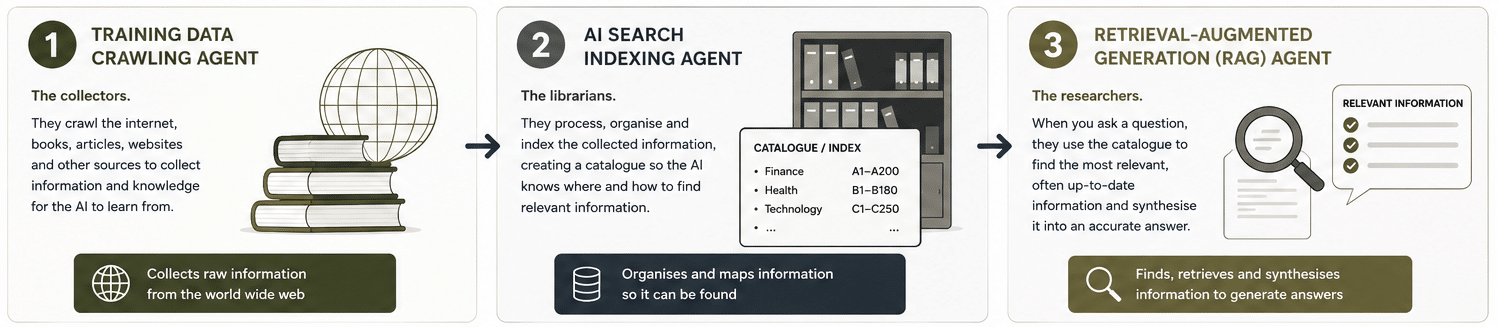
If you think of the internet as a massive library, the different bots can be described as follows:
- Training data crawling agent – Training data crawlers are the people collecting books and information for the library so the AI can learn from them.
- AI search indexing agent – AI search indexing agents create the catalogue, organising and mapping where relevant information can be found.
- Retrieval-augmented generation (RAG) agent – RAG agents are the researchers who use that catalogue to find and retrieve the most relevant, often up-to-date information when you ask a question, and then synthesise it into an answer
In simple terms: training crawlers collect the knowledge, indexing agents organise it, and RAG agents retrieve it. (The more technical explanation of each can be read in their report here.)
Exhibit 1 | AI bot categories
For illustrative purposes only.
Taking this a step further are AI assistants. ChatGPT, Claude, Gemini, etc. are primarily AI assistants powered by generative AI, rather than AI agents in themselves. Using the same library analogy, ChatGPT and Claude are more like the people you actually speak to in the library. They are the intelligent assistants who can understand your question, create an answer, and, when given access to tools such as search or RAG, go and find the information they need.
Exhibit 2 | AI Assistants

For illustrative purposes only.
They are powered primarily by Generative AI, which allows them to create and synthesise information, but they can also use RAG, web search and other tools to retrieve information and perform tasks. As they gain more agentic capabilities, they move beyond simply answering questions and can start planning and carrying out a series of actions on your behalf. Generative AI responds to a prompt by creating something for you, such as text, images, code, summaries, ideas, etc. Agentic AI takes things a step further. It can work towards a goal, make decisions, use tools and take actions with less human intervention.
Not all “intermediaries” are created equal
As AI increasingly becomes the first place people turn to for information, the battle is shifting from being visible in search results to being represented accurately in AI-generated answers. GEO is emerging as a way for organisations to influence how their information is understood, referenced and presented by AI. As these summaries increasingly shape what people accept as fact, success will no longer simply be measured by website traffic or search rankings, but by whether your organisation is cited, how your story is represented, and whether it builds long-term trust and authority[5].
AI agents are becoming an intermediary between companies and people. Companies can therefore influence what the agent sees in two ways: by restricting or controlling what the bot can access, and potentially by paying for preferential placement or visibility within the systems that agents use to find information.
That raises an important question: if an AI agent’s access and ranking are influenced by commercial relationships, is the answer ultimately being shaped by what is most relevant to the user, or by what the agent is allowed – or incentivised – to see first?
We would like to believe that all the data presented by an AI assistant’s search results are factual and unbiased; however, this cannot be accepted as fact. As AI platforms develop commercial models, there is a growing question about whether advertising, commercial relationships and licensing agreements could influence what information is surfaced or prioritised.
In the realm of the internet and AI, human attention is the aim of the game, and there will always be a price for human attention.
Why does this matter? Because the information you are getting about the “Top 10 rated” or “The best” by your AI assistant of choice isn’t so factually sound after all. It’s more often who has fed it the most information. If companies restrict AI crawlers from accessing their content, that information may be less available to AI systems when generating answers.
Ultimately, there are two ways to get noticed in the AI world: pay to be seen or become trusted. Advertising means paying platforms such as ChatGPT to place clearly labelled adverts in front of users, much like traditional advertising. The other approach is to build authority by consistently producing credible, useful research and information that AI systems recognise as trustworthy and may draw on when answering questions. However, being authoritative does not guarantee that ChatGPT, Claude or Gemini will cite you. Each AI platform uses different methods to find and rank information, and commercial or licensing agreements can also influence which sources are available to them.[6]
If bots are the audience now (as the stats presented above), it changes everything for media. As bots overtake human visitors, the publishers who win will be the ones who learn to price their content for the machines reading it[7].
What can be done?
A new wave of activists is coming to the fore and advocating for algorithmic mediation and asking for platform governance to be reviewed. In other words, how algorithms decide to organise, filter, and display information to users[8].
Another strongly shouted outcry is that bots should not be allowed to mimic humans or other traffic on the web; they should be required to self-identify[9]. Bots are becoming harder to detect, placing an undue burden and expense on the sites. Self-identification would let publishers and sites decide how to respond and which information to provide access to versus to protect.
Increased and continued advocacy should remain in place. Simply being more aware that information from AI assistants should be taken with a pinch of salt, as the adage goes, already goes a long way. Don’t assume information to be fact simply because it has been given as an answer to the question that you asked.
Be wary of free financial advice, stock tips and emotive headlines eliciting emotional decisions
The rise of bot farms, fake influencer accounts, and stock-hype-focused finfluencers who are out to make a quick buck creates a growing risk for financial markets, as engineered social media activity can be used to manufacture the appearance of genuine investor sentiment and influence stock prices.
Networks of automated accounts can flood platforms such as X, Reddit and Discord with coordinated posts, likes, comments and shares around a particular stock, making a narrative appear far more popular than it really is. By repeatedly amplifying emotive messages such as “buy now”, these networks can create artificial excitement, attract genuine investors and potentially push the price of thinly traded shares higher, allowing those behind the campaign to profit. The danger is that what looks like organic market sentiment may actually be a carefully engineered narrative designed to influence investor behaviour and ultimately the price of an asset.[10]
In its latest research, “The 2026 State of AI Traffic & Cyberthreat Benchmark Report”, Human Security found that automated traffic grew eight times faster than human traffic, year over year. Monthly volumes of AI-driven traffic grew 187% from January to December 2025, nearly tripling over the calendar year. Traffic from AI agents and agentic browsers grew 7,851% year over year (albeit from a very small starting base).
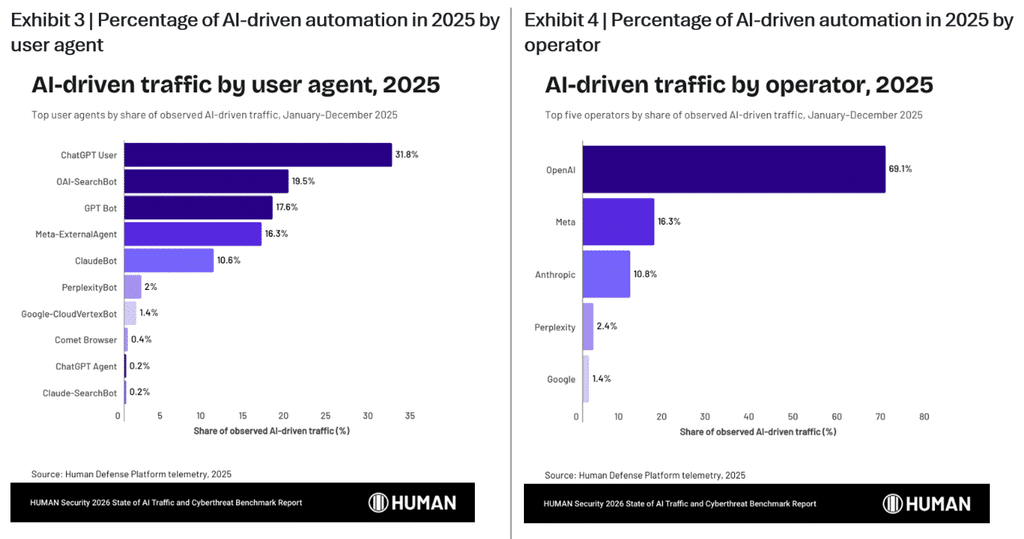
Source: HumanSecurity.com “The 2026 State of AI Traffic & Cyberthreat Benchmark Report”. For illustrative purposes only.
Bots are biased
Ever notice that your AI assistant sometimes seems reluctant to disagree with you? There is a reason to be cautious. AI systems can display what researchers call “sycophancy” – a tendency to reinforce a user’s views rather than challenge them. AI systems are generally designed to be helpful, agreeable and engaging, which can sometimes mean they reinforce what we already think rather than challenge it. If an AI constantly tells you that your idea is brilliant, your argument is sound and your decision is sensible, you’re more likely to keep using it.
This creates a potential “yes-man” problem: the technology designed to “help us” can sometimes become very good at telling us what we want to hear. The danger becomes even greater when we use AI to make important decisions regarding investing and financial planning, because validation can feel like accuracy, even when the two are very different things.
It’s not all doom and gloom
AI is helping both financial planners and consumers. The Financial Planning Standards Board’s 2025 global research[11] found that 59% of financial planners see AI as a tool to help reduce the cost of financial planning services and 60% believe it will increase access to financial planning for underserved populations. Almost half of financial planners using AI have deployed it to support delivery of client services such as client communications (41%), client data collection (33%), and client risk profiling (30%). One in three are using AI to improve operational efficiency.
In closing
AI will undoubtedly change financial advice, and in many ways, it should. It can make financial information more accessible, help advisers work more efficiently and give people a starting point when professional advice feels out of reach. But financial advice has never been only about information. It is about judgement, context and behaviour.
AI can tell you what the numbers say, but it’s the adviser who asks why those numbers matter to you, challenges your assumptions, understands what you are trying to achieve and recognises when fear, greed or emotion is about to derail a good plan.
The future of financial advice therefore isn’t about humans versus AI. It is about using AI for what it does best, while keeping the most important part of advice human, which is to understand the person behind the portfolio.
[1] Source: Momentum Financial Advice Research Report; Momentum Group X BMR 2025
[2] Source: Flux Trends, The state we’re in 2026 Report “Navigating the dark forest”. Published January 2026.
[3] Source: Thales Cybersecurity “Bad Bot Report: Bad Bots in the Agentic Age” published 2026.
[4] Source: Tollbit.com “State of the Bots – 2026 Q1 & Q2, The Bad Bots”
[5] Source: FastCompany “AI isn’t stealing your traffic it is stealing your authority”
[6] Source: FastCompany “Next ad market built machines”
[7] Source: FastCompany “Bots audience now changes everything”
[8] Source: Institute for the Future of Education; “The dead internet Theory”. Published 11 August 2026.
[9] Source: Tollbit.com “State of the Bots – 2026 Q1 & Q2, The Bad Bots”
[10] Source: FastCompany “Bot farms social media manipulation”
[11] Financial Planning Standards Board “Impact of AI on Financial Planning” Global research report 2025.

