


You will hear a lot about El Niño over the next few months as drought, poor harvests and higher food prices make headlines. These risks are real. As with most crises, the story is not only negative. A weather shock does not affect every company or country in the same way, and where some lose, others gain. In this article, we explain what El Niño is, what it could mean, and where we see opportunities.
What is El Niño?
Every few years, the Pacific Ocean near the equator becomes warmer than usual. That warm water changes where rain falls around the world: some regions become hotter and drier, while others get more rain. This warm phase is called El Niño. Its opposite, when the same ocean cools down, is called La Niña.
For South Africa, El Niño usually means a hotter and drier summer, which matters most for our maize crop and food prices. Last season we had La Niña, which brought good rains and a record maize harvest.
This El Niño is a big one. It is expected to be the strongest since records began in 1950, peaking towards the end of 2026 and lasting into the first half of 2027. It is also likely to be the hottest El Niño on record. With that said, stronger does not automatically mean worse. Two of the strongest past events, in 1997/98 and 2009/10, did not cause drought in South Africa, and in 2009/10 the country actually had a bumper maize harvest. What really matters is how much rain falls; not how strong the El Niño is.
Let’s consider the impact at a glance:
- Food prices will be impacted: Global prices for crops such as rice, wheat and sugar have already risen sharply this year, by more than in past El Niño periods. If our summer rains disappoint, local maize prices could rise by around 20% by year-end.
- South Africa starts in a good position: We have a record maize crop in storage, and food inflation was only 0.7% in August. This gives us a cushion which we did not have in previous droughts.
- Household budgets and interest rates under pressure: Together with high fuel prices, higher food prices would squeeze household spending and could delay interest rate cuts.
- Other countries are more exposed. The biggest impact is expected in countries where farming is a large part of the economy, such as parts of Latin America, Asia and some African countries. South Africa is seen as relatively low risk.
Not everything is negative
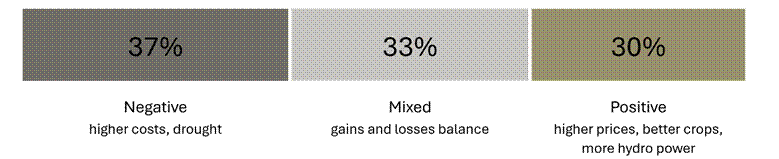
A useful way to judge the real impact is to listen to what companies themselves are saying. A recent review looked at the latest results of 73 large companies worldwide in farming, food, energy, insurance and transport. Of the 27 that talked about El Niño, only about a third expect its impact to be negative. A third saw a mixed picture, and almost a third saw it as a positive forecast.
Exhibit 1 | How 27 global companies described the impact of El Niño
Source: Morgan Stanley Research, “El Niño: Implications for Macro and Markets”, published 10 September 2026. Past performance is not indicative of future performance. For illustrative purposes only and not indicative of any investment.
Why would anyone benefit from a drought? Because when crops fail in one region, prices rise for everyone, and producers elsewhere earn more. Companies that help farmers protect their crops see more demand while some regions actually get more rain during El Niño.
Likely winners include companies that supply farmers with fertiliser, seed and crop protection; farm equipment makers; farmers in regions that receive more rain; discount retailers as shoppers look for better value; and hydro-power companies with full dams. On the other side, farmers in drought-hit areas, meat and food producers facing higher feed costs, and insurers that cover weather damage are more likely to feel the pressure.
Opportunities closer to home
- Heavy rain in Chile and drought in Zambia can disrupt copper mines, which tends to push metal prices higher. This supports South African resource (mining) companies.
- Warmer ocean water disrupts fishing off South America, which has pushed up global fishmeal prices. This is positive for Oceana, whose share price is up about 17% this year.
- At the moment, the worst impact seems to be on the price of food producers’ shares, increasing their perceived value.
- It may seem that insurers would suffer, but history shows the opposite situation for South Africa: La Niña, with its storms and floods, is more difficult for local short-term insurers, while El Niño has had little effect on the insurers.
What could go wrong
- Two bad seasons in a row: Because this El Niño may last into 2027, there is a risk of two poor rain seasons back-to-back, which would do much more damage than one.
- Staple food price fluctuations: White maize and bread are the most sensitive to these weather patterns, and they hit lower-income households the hardest.
- Buying too late: Many crop prices have already risen a lot. Chasing these moves now carries the risk of buying at the top.
- Rain is what counts: The forecasts can be wrong. We will watch the actual rainfall from October to March closely, and adjust as the picture becomes clearer.
Our view
El Niño will cause real damage in parts of the world, and we are not dismissing these risks, but a strong El Niño does not have to be a hardship for investors. South Africa starts with full grain stores and low food inflation; many price moves have already occurred, and most companies see the effect as neutral or even positive.
Every crisis creates opportunities. Our approach is to stay calm, avoid reacting to headlines, and position carefully in the areas that stand to benefit, while protecting portfolios against the risks.
__________________________________________________
Sources:
Morgan Stanley Research, “El Niño: Implications for Macro and Markets”, 10 September 2026
Standard Bank (SBG Securities), “Weather and soft commodities: El Niño has arrived”, 4 September 2026
Investec, “SA Strategy: Contrarian Trades”, 22 September 2026
Investec, “Food Producers: Protein and carb update – Has Food CPI bottomed?”, 23 September 2026
Investec, “SA Non-life Insurance: El Niño – Where, what and how matters”, 4 June 2026

