


“When a flower doesn’t bloom, you fix the environment in which it grows, not the flower.” – Alexander Den Heijer
Trusts, family planning, estates, and structuring tax as effectively and efficiently as possible are the “bread and butter” of financial advisers. This is, and will remain, true as long as people have families and raise children. But a new cohort of clients has quietly grown up and now requires a different specialisation: clients with no children.
These clients have “fur-kids”, pursue entrepreneurial ventures, and treat life as an adventure – gathering as many experiences as they can, often while working from different corners of the globe. They are not a niche. They are a growing share of every adviser’s future book, and the traditional planning playbook was not written with them in mind.
The roadmap to happiness is being questioned
The traditional “recipe for happiness” involved finding a partner, getting married, buying a house and having children. The further we move into the 21st century, the further we seem to move away from that path. Social media now sums it up rather differently: “Today, plants are the new pets. Pets are the new kids. Kids are like exotic creatures: you have to be crazy or rich to have them.”
The numbers back the joke. In South Africa, the average woman in 1960 could expect to have about six children; today the figure is just over two[1].
Exhibit 1 | South Africa’s fertility rate has fallen from about six to just over two children per woman
Total fertility rate, births per woman, 1960–2024
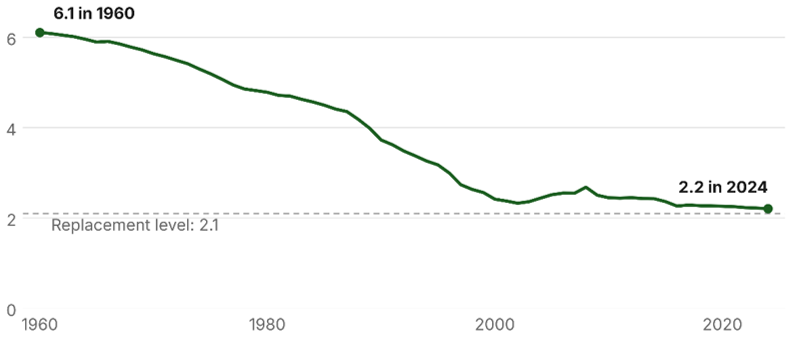
Source: World Bank, World Development Indicators, site via FRED, Federal Reserve Bank of St. Louis, cited November 2026. For illustrative purposes only.
Stats SA’s 2026 mid-year estimates put the total fertility rate at 2.12, hovering just above the replacement level of roughly 2.1 children per woman[2]. Gauteng and the Western Cape, the provinces where most advisers’ clients live and work, are already below that national average[3]. Globally, the shift is even starker: the average fertility rate has fallen from 5 children per woman in 1950 to 2.25, is expected to reach 2.1 by 2050, and one in four people already live in a country whose population has peaked[4].
Not just fewer babies – more deliberate decisions
Falling fertility is often framed as a biological or policy problem. The evidence points elsewhere: parenthood has shifted from default to decision. UNFPA notes that more people are voluntarily choosing to remain child-free, and that this can offer alternative paths to happiness and fulfilment[5]. Economists Fernández-Villaverde and Norrick go further, suggesting that modernity itself makes a third child expensive and childlessness cheap[6]. Locally, News24 reports that more South African men and women are delaying parenthood[7].
The reasons people give for deciding not to have children are varied, and usually several apply at once:
- Money: In UNFPA’s 14-country YouGov survey, 53% of South African respondents cited financial limitations as a reason for having fewer children than they wanted – among the highest of any country surveyed, against a 39% average.
- Job insecurity: A third (33%) of South Africans cited unemployment or job insecurity, the joint-highest figure in the survey.
- Housing: 17% of South Africans pointed to housing costs or lack of space.
- No suitable partner: 18% of South African respondents said the lack of a (suitable) partner was a factor – the “find a partner” step of the old recipe is no longer a given.
- A change of heart: 17% simply decided they wanted fewer children, and 18% said their partner did.
- Worry about the future: 15% of South Africans cited the political or social situation, and 9% cited climate change.
- Health and infertility: 15% of South Africans cited infertility or difficulty conceiving – a reminder that not every child-free client is child-free by choice.
- Later starts: People are having first children later, which is now socially acceptable but can collide with declining fertility from the mid-30s.
- Career, education and autonomy: Fertility is lowest in the most urbanised provinces, Gauteng and the Western Cape[8] where education, careers and independence compete hardest with parenthood.
Unless otherwise linked, figures are from the UNFPA/YouGov survey in the State of World Population 2025 report. That question was put to people who want or have children, so it captures those scaling back; the voluntarily child-free sit on top of these numbers.
For advisers, the distinction matters: some clients chose this path with open eyes, others arrived at it through grief or circumstance. Both need a plan, but not the same conversation.
A heavier load on younger shoulders
Fewer births today mean fewer workers tomorrow supporting more retirees. A McKinsey Global Institute report calculates that the global support ratio (working-age people per person over 65) fell from 9.4 in 1997 to 6.5 today and is expected to drop to 3.9 by 2050. In the world’s ageing economies, retirement systems might need to absorb as much as half of labour income. Absent action, younger people will inherit slower growth, carry the cost of more retirees, and see the traditional flow of wealth between generations erode.
The IMF adds that in countries whose populations are shrinking, the share of people aged 65 and older will almost double, from 17.3% to 30.9%, between 2025 and 2050[9]. South Africa is earlier on this curve: its population is still youthful, but Stats SA already notes that child dependency is falling as fertility declines and life expectancy rises[10]. McKinsey’s warning to “later wave” countries is blunt: take note.
For advisers, this has two edges. Today’s young clients may face higher taxes, thinner government support and a longer working life. And child-free clients cannot assume that the next generation (theirs or anyone’s) will be there to catch them.
What to plan for when there are no children
A child-free plan is not a family plan with the children deleted. The questions change from “who do I provide for?” to “who looks after me, and what do I want my money to mean?”
The following factors should be considered:
- A valid will – urgently: Without one, the Intestate Succession Act sends the estate to parents, then siblings and their children; friends, charities and unmarried partners could end up receiving nothing, and with no relatives, the estate goes to the state[11].
- Incapacity planning: South Africa has no enduring power of attorney; it lapses once the principal loses mental capacity[12]. With no adult children to step in, consider trusts with clear successor trustees, a living will, and a named person to manage affairs.
- Longevity and care: Budget for frail care, retirement living and care management that children might otherwise have provided informally, and use guaranteed income to insure against outliving capital.
- Beneficiary nominations: Retirement fund benefits are allocated by trustees under section 37C of the Pension Funds Act; for a client without dependants, an up-to-date nomination carries more weight.
- A purposeful legacy: Nieces, nephews, godchildren, a mentee’s education or a cause. Bequests to approved public benefit organisations can also reduce estate duty.
- The fur-kids: In law, pets are property. Leave the animal, and money for its care, to a named carer – or to a trust.
- Right-sized cover: Less need for income replacement for dependants; more need for disability, severe illness and estate-liquidity cover.
- A global, entrepreneurial life: Tax residency, offshore assets and separate wills for foreign assets for clients who work across borders; buy-and-sell and key-person cover for business owners.
- A spending plan: For many, the goal is not to leave the most, but to fund a rich life and run down capital deliberately.
How advisers need to shift their thinking, and their dated “script”
The biggest change is not technical but rather a change of assumptions. It starts with dropping the default script. Opening with “and the kids?” or school-fee planning signals that the adviser’s model doesn’t include the client, so ask instead about the people, animals and causes that matter – and ask with care, because while some clients chose this path, others came to it through infertility, loss or circumstance, and they should set the tone.
It can also mean redefining “family”. For clients without children, their chosen family, whether partners, friends, siblings or godchildren, often plays the role descendants once did, and plans, nominations and trusts should reflect that.
Advisers must also plan for the client’s own life. Without a younger generation as a safety net, the adviser may be the only person with the full picture, so building a trusted network of attorneys, fiduciaries and care professionals becomes part of the service.
Finally, success needs to be measured differently. It might not be measured by wealth transferred, but rather by freedom funded: experiences, ventures and impact while the client is alive to enjoy them.
The child-free client is not a problem to be solved. The planning environment simply has not caught up. As Den Heijer reminds us, when the flower doesn’t bloom, you fix the environment. Advisers who adapt theirs will find a large, growing and loyal market waiting.
_______________
Additional References
Further reading: Macrotrends, South Africa Birth Rate 1950–2026; Stats SA, #WomensMonth2026 post on total fertility.
[1] Source: World Bank (2026). Fertility Rate, Total for South Africa (SPDYNTFRTINZAF), World Development Indicators, via FRED, Federal Reserve Bank of St. Louis.
[2] Source: Statistics South Africa (2026). Population Growth in SA Remains Steady as Fertility Declines.
[3] Source: Statistics South Africa (2026). Mid-year population estimates 2026 – presentation.
[4] Source: UNFPA (2025). State of World Population 2025: The Real Fertility Crisis.
[5] Source: UNFPA (2025). State of World Population 2025: The Real Fertility Crisis.
[6] Source: Fernández-Villaverde, J. & Norrick, P. (2026). Terra Incognita: The Economics of a Shrinking World. NBER Working Paper 35809.
[7] Source: News24 (2026). SA’s declining birth rate: Is parenthood losing its place on the traditional life checklist? 14 August 2026.
[8] Source: Statistics South Africa (2026). Mid-year population estimates 2026 – presentation.
[9] Source: Bloom, D.E., Kuhn, M. & Prettner, K. (2025). The Debate over Falling Fertility. Finance & Development, IMF, June 2025.
[10] Source: Statistics South Africa (2026). Mid-year population estimates 2026 – presentation.
[11] Source: LegalWills South Africa (2026). Intestate Succession in South Africa: What happens if I die without a will? Updated 19 February 2026.
[12] Source: IOL (2026). When a Power of Attorney isn’t enough. 6 June 2026

