


Longevity is one of the most predictable trends in investing. Its consequences for investors, advisers and markets are not.
Demographics are usually treated as background noise, but should not be anymore. People are living longer, and the over-60s are now one of the fastest-growing and most influential groups in the global economy. That single shift is reshaping three things at once: how long an investor’s money needs to last, what an adviser’s job looks like, and where companies will find decades of new demand.
Unlike most market forecasts, this one rests on solid ground. We cannot know where markets will trade in 2040, but we know roughly how many 70-year-olds there will be because they have already been born. The harder question is what that means for portfolios.
A world growing older
Consumers aged 60 and older spend about US$18.7 trillion a year, more than a quarter of global consumer spending. That is almost double the 2016 figure, and it is projected to reach US$34.2 trillion by 2036.[1]
Japan offers a glimpse of what lies ahead. Almost a third of its population is 65 or older[2]. Adult incontinence products have outsold baby nappies there for years, and in 2024 Oji Holdings’ nappy subsidiary stopped producing baby nappies in Japan to focus domestic production on adult products[3]. When demographics change, the economics of entire product lines change with them.
South Africa is far younger, but moving in the same direction. The number of people aged 60 and older rose from about 3.6 million in 2002 to 6.6 million in 2025, around 10.5% of the population. Older persons headed 20.6% of households in 2024[4].
A non-smoking American couple aged 65 and in excellent health has roughly a 75% probability that at least one partner will reach 90[5]. South African life expectancy varies considerably with health and access to care, but a retirement that stretches into the 90s is now a realistic planning scenario.
Living longer is something to celebrate. It is also a financial puzzle that plays out at three levels: the investor, the adviser and the investable universe itself.
The investor: the 30-year retirement
Imagine retiring at 65 and funding that lifestyle until 95. For a growing number of retirees, the real risk is not dying too soon but outliving their savings. Over 30 years, longevity magnifies every other risk.
- Inflation compounds: At an illustrative 5% a year, something costing R20,000 today would cost about R86,000 in 30 years. Retirees also experience their own inflation rate: medical scheme contributions and out-of-pocket healthcare costs take up a growing share of spending and often rise faster than headline CPI[6].
- The order of returns matters: Two investors can earn identical returns over 20 years in a different sequence. The one who meets a market fall early in retirement must sell assets at depressed prices to fund income, leaving less capital for the recovery[7].
- Small withdrawal choices have large consequences: South Africa’s average living-annuity drawdown rate was about 6.6% in 2025[8]. Consider R5 million invested at 65, earning a steady inflation plus 3.5% a year after fees, with income rising in line with inflation. Under these simplified assumptions, a 6.6% starting income would exhaust the capital at around 86 or 87. At 5%, it could last until about 99, and at 4% substantial capital would remain.
Exhibit 1 | R5 million retirement capital at different starting income rates
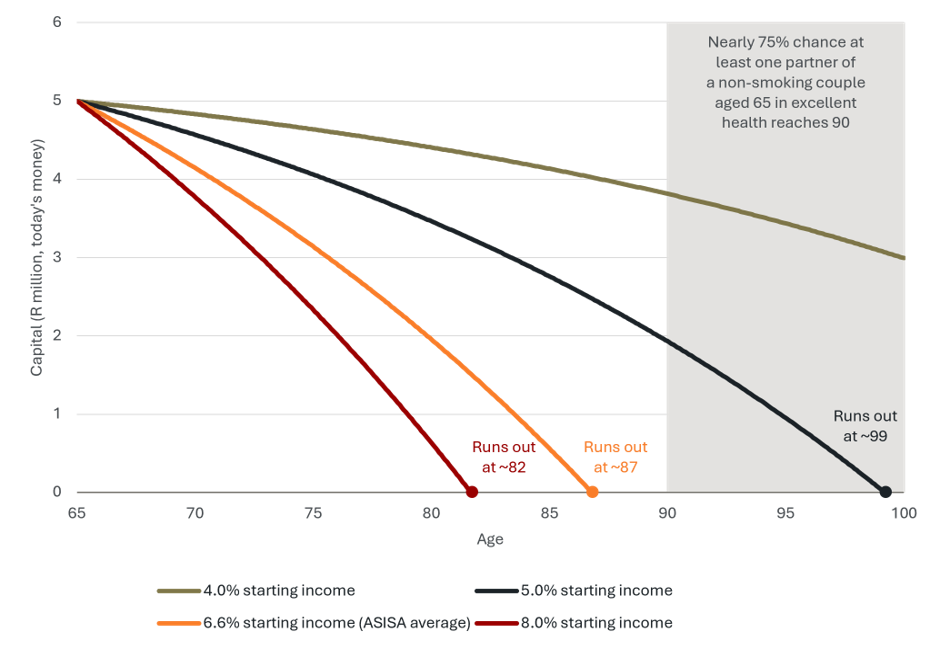
Source: OIG calculations. Assumes R5 million invested at age 65. Income is set as a percentage of starting capital, paid monthly and increased with inflation each year. Inflation is assumed at 5% a year, and investments earn a constant 8.5% a year after fees (inflation plus 3.5%), which is an assumption and not a guaranteed return. Capital is shown in today’s money (adjusted for inflation). Shaded area: American Academy of Actuaries and Society of Actuaries, Actuaries Longevity Illustrator (US data), based on a non-smoking couple aged 65 in excellent health. For illustrative purposes only and not indicative of any investment.
This is why playing it safe can be risky. A 65-year-old planning for another three decades is still a long-term investor. Moving everything into cash reduces volatility but risks falling behind inflation. Holding only growth assets while drawing an income invites forced selling in downturns. The task is to balance reliable income today with enough growth for tomorrow.
The adviser: from building wealth to making it last
Longevity changes the adviser’s brief. For decades, the goal was to help clients accumulate enough to retire. Now the goal is to make that wealth last as long as the client does, which is a harder, longer and more personal problem.
One practical answer is to separate near-term income from long-term growth. A dedicated income allocation funds regular withdrawals, while growth assets stay invested through market cycles, reducing the need to sell equities when prices are weak.
This philosophy underpins OIG’s Alternative Income Provider (AIP). It does not remove market risk: the income allocation must be sized, monitored and replenished, and the growth portfolio kept diversified. The point is to manage different risks over different time horizons.
The client conversation broadens too. Advisers should test every retirement plan against five questions:
- What if I live to 95? Plan for longer lifespans, not averages.
- Is my income sustainable? Review withdrawal rates against returns, inflation and remaining capital.
- Can my portfolio withstand a crash? Know how income will be funded during prolonged weakness.
- Am I protecting my purchasing power? Healthcare and living costs may rise faster than headline inflation.
- When did I last review my plan? Markets, health and spending needs all change.
Care costs, living arrangements and estate planning now matter as much as investment returns.
The investable universe: two silver economies
The shift that lengthens retirement is also redrawing the opportunity set. Older consumers are not only patients: the silver economy has two halves. Healthy, active ageing drives demand for travel, leisure, wellness, consumer brands and financial planning. Ageing with growing care needs drives demand for pharmaceuticals, medical devices, assisted living and home healthcare.
The sums involved are large. PGIM and Oxford Economics estimated that ageing alone could add about US$325 billion a year to US nursing-home spending by 2070, compared with 2015[9]. That is historical modelling rather than a current forecast, but it shows the scale. Businesses that keep people healthy and independent for longer, such as remote monitoring or continuous glucose monitors, may matter as much as those treating age-related illness.
A trend is not a return. We test themes like this with three questions, and our confidence falls at each step:
- Will demand grow? Demographics answer this with high confidence.
- Who captures it profitably? That depends on competition, pricing power, regulation, innovation and who pays.
- Is it already in the share price? That depends on valuation and market expectations.
Hearing aids illustrate the gap. Demand will almost certainly grow, yet cheaper over-the-counter devices, new competitors, reimbursement rules and the price paid for the shares all stand between a growing market and a good investment.
Who pays matters
Spending is highly concentrated: the wealthiest 8% of over-60s account for about 43% of the group’s spending[10]. In South Africa, many older people rely on the state old-age grant and family support. A retirement village for affluent households and a healthcare provider for people with little disposable income both serve an ageing market, with very different economics.
What helps companies can weigh on economies
A shrinking share of working-age people strains labour supply, tax revenues and public finances, even as demand for healthcare, automation and specialised services rises. Economic growth and investment opportunity are not the same thing.
South African investors therefore do not need a dedicated silver-economy fund. Globally diversified equity portfolios already hold healthcare, medical technology, consumer and financial businesses. What matters is how those exposures fit with sector concentration, currency risk and valuation. This is where manager research earns its place: we look for managers who understand structural demographic shifts, separate sustainable earnings growth from temporary enthusiasm, and stay disciplined when valuations become stretched.
One trend, three conversations
The retiree who needs growth to fund a 30-year retirement is also the consumer driving the silver economy. Longevity creates the problem and, for disciplined investors, part of the solution. This is not a bet on the next market cycle. It is a structural change in how the world lives, spends and saves. For investors, it means treating retirement as a long-term investment horizon.
For advisers, it means planning for lives, not averages. For the market, it means separating the businesses that will profit from ageing from those whose prospects are already priced in.
Demographics tell us where demand is going. Investment discipline tells us where the returns might be, and how to make them last as long as we do.
[1] Source: World Data Lab, “The world’s over-60s now spend $18.7 trillion a year and will spend $34.2 trillion by 2036”, 17 June 2026.
[2] Source: World Economic Forum, article on Japan’s ageing population, updated September 2023.
[3] Source: Nonwovens Industry, “Oji Holdings to stop producing baby diapers in Japan”, 1 April 2024.
[4] Source: Statistics South Africa, “Marginalised Groups Series VIII: Healthy Ageing in South Africa, 2024”.
[5] Source: American Academy of Actuaries and Society of Actuaries, Actuaries Longevity Illustrator (US data, non-smoking couple aged 65 in excellent health).
[6] Source: University of the Witwatersrand, “Retirement Reimagined”, March 2025.
[7] Source: Just SA, “The Four Retirement Risks and How to Manage Them”, May 2025.
[8] Source: ASISA, 2025 living-annuity industry statistics, as reported by Moonstone, September 2026.
[9] Source: PGIM, “A Silver Lining: The Investment Implications of an Ageing World”, with Oxford Economics (c. 2016). Historical modelling from a 2015 base, not a current forecast.
[10] Source: World Data Lab, “The world’s over-60s now spend $18.7 trillion a year and will spend $34.2 trillion by 2036”, 17 June 2026.

