

In September, global markets were shaped by a broad turn higher in interest rates and a renewed jump in oil prices. The US Federal Reserve (Fed), the European Central Bank (ECB) and the Bank of Japan all raised rates, while the Bank of England (BoE) came within one vote of doing so. Brent crude climbed back above $100 a barrel as US-Iran talks over the Strait of Hormuz stalled, and government bond yields rose sharply worldwide. A narrow group of technology shares kept the US NASDAQ 100 in positive territory, but most other markets fell, and gold gave back part of August’s surge.
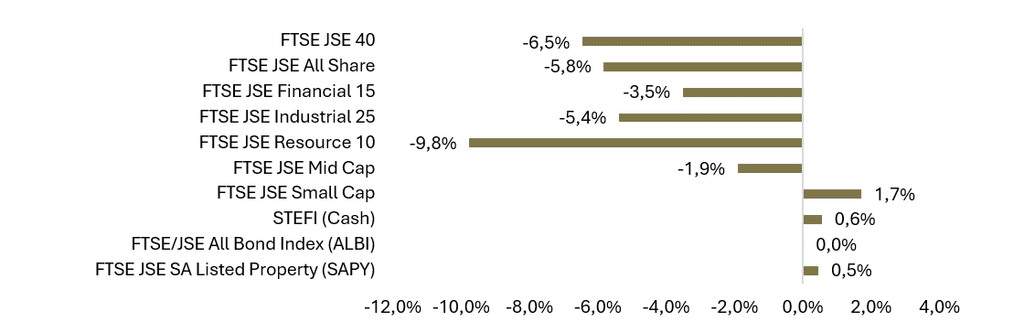
South Africa gave back much of August’s gain, with the FTSE/JSE All Share Index (ALSI) falling -5.8% and the Top 40 down -6.5% as gold and platinum miners reversed sharply. The rand weakened about -1.5% against the dollar to around R16.42, and local bond yields rose. The South African Reserve Bank (SARB) raised the repo rate by 25 basis points to 7.25%, citing the oil shock. August inflation (CPI) edged up to 4.4% from 4.3%.
LOCAL MARKETS
Exhibit 1 | Local Performance (ZAR) for September 2026
South Africa
Economy
South Africa’s inflation edged higher in August. Annual consumer prices rose from 4.3% to 4.4% in July, coming in slightly below the 4.5% consensus forecast. Prices were flat over the month. Transport remained the main source of pressure at 8.8%, while housing and utilities rose 5.2%, with electricity and other fuels up 8.3%. Food and non-alcoholic beverages ticked up from 0.9% to 1.1% – the first acceleration in nine months. Core inflation, which strips out food and energy, eased from 4.2% to 4.1%.
The economy contracted by -0.2% in the second quarter, the first decline after six consecutive quarters of expansion, as trade, manufacturing and mining all shrank. Even so, the Monetary Policy Committee (MPC) voted unanimously on 23 September to raise the repo rate by 25 basis points to 7.25%, taking the prime lending rate to 10.75%. The SARB described the oil price rise as a large and persistent supply shock, and said it expects inflation to rise above 5.0% in late 2026, and cut its 2026 growth forecast to 1.2%.
South African equities had a difficult month. The ALSI fell -5.8% and the Top 40 -6.5%, as the forces that drove August’s rally went into reverse.
The Resource 10 index fell -9.8% as gold and platinum prices retreated. Financials lost -3.5%, industrials -5.4% and mid-caps -1.9%. Only the smaller and more defensive corners of the market held up: small caps gained 1.7% and listed property 0.5%.
Sector performance was broadly negative:
- Gold and platinum miners led the declines. Rising US interest rates and a stronger dollar pulled bullion lower, and the same leverage that lifted local producers in August worked against them in September.
- Energy and selected domestic shares provided some offset. Sasol benefited from the jump in oil prices, while food and healthcare retailers and investment holding companies held their ground as investors sought more defensive exposure.
- South Africa lagged its peers, with the ALSI’s -5.8% fall well behind the MSCI Emerging Markets Index’s -0.6% decline.
Overall, September showed how quickly the resource trade can reverse. Over the past twelve months, the Resource 10 has returned 10.7% and the Financial 15 23.6%, while the Industrial 25 has fallen -16.5%, leaving the ALSI up 4.6%.
Best performers:
Sasol 17.5%
Shoprite 5.9%
Clicks Group 5.3%
Remgro 3.8%
Old Mutual 2.9%
Worst performers:
Gold Fields – 17.2%
AngloGold Ashanti – 14.6%
Pan African Resources – 11.4%
Naspers – 11.2%
Pepkor – 9.7%
Bond market and currency
The rand weakened through September as the dollar strengthened after the Fed’s rate increase, oil climbed, and precious metals fell. The currency traded between roughly R15.94 and R16.44 against the dollar and ended the month at around R16.42, a loss of about -1.5%. It held up better against the European currencies, firming about 0.7% to R18.60 against the euro and 0.5% to R21.78 against the pound, as both also fell against the dollar.
Local bond yields rose modestly. The SA 10-year yield moved above 9.0% mid-month, its highest level since April, and ended September near 8.96%, while the 20-year yield ended near 9.53%. Higher oil prices, the SARB’s rate increase and a sharp rise in US Treasury yields all weighed on the market.
The All Bond Index (ALBI) was flat at 0.01%, while the Short-Term Fixed Interest Index (STEFI) returned 0.6%, so cash outperformed bonds. With the SARB now tightening and inflation forecast to rise above 5.0%, bonds are likely to stay sensitive to oil and the rand ahead of the 19 November MPC meeting.
GLOBAL MARKETS
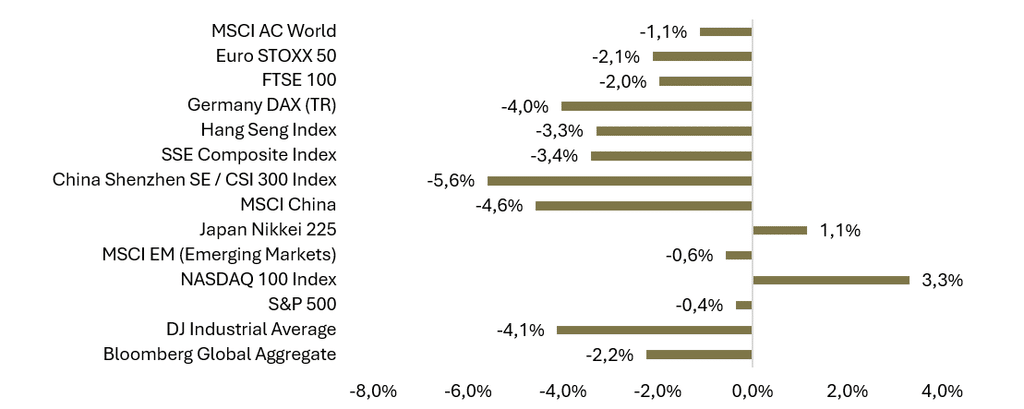
Global markets fell in September as central banks turned more hawkish and oil prices climbed. The Fed raised rates for the first time since 2023, the ECB and the Bank of Japan followed, and yields on long-dated US and UK government bonds rose to their highest levels in decades. The dollar strengthened, precious metals retreated, and only the large technology names held up. The MSCI All Country World Index (MSCI World) lost -1.1%.
Exhibit 2 | Global Performance (base currency) September 2026
Source: Morningstar. Data as at 30 September 2026. Past performance is not indicative of future performance. For illustrative purposes only and not indicative of any investment.
United States
US equity markets were sharply divided. The US NASDAQ 100 rose 3.3% as investors kept buying semiconductor and AI-linked shares, but the S&P 500 slipped -0.4% and the Dow Jones Industrial Average fell -4.1%. Software, financial, consumer and industrial shares bore the brunt of the selling, and smaller companies fell more than -5.0%.
The economy proved firmer than August’s data had suggested. August payrolls rose by 162,000, well ahead of expectations, and the unemployment rate held at 4.1%. Consumer price inflation stayed at 3.4%, with petrol prices up more than 27.0% on the year, while core inflation eased to 2.4%. Consumer confidence, however, fell to its lowest level since 2014.
The Fed raised its policy rate by 25 basis points to a target range of 3.75% – 4.00% on 16 September, its first increase since 2023, in a unanimous vote. Most policymakers expect at least one further increase this year. Chair Kevin Warsh said inflation had been too high for too long, and markets ended the month pricing in nearly an even chance of another move in October.
Bond markets came under heavy pressure. The 10-year Treasury yield rose about 0.5 percentage points to end near 5.27%, its highest level in nearly two decades, and the US dollar index climbed about 2.0% to 101.45.
Europe
European equity markets fell. Germany’s DAX Index lost -4.0% and the Euro STOXX 50 -2.1%, as higher oil prices, rising bond yields and upcoming elections in several member states weighed on sentiment.
The ECB raised its deposit rate by 25 basis points to 2.50% on 10 September, its second increase this year, and warned that the risks to inflation are tilted to the upside. Eurozone inflation was confirmed at 3.2% for August, with energy prices up 14.3% on the year, and early September readings from Germany and Italy pointed higher still.
United Kingdom
The UK FTSE 100 fell -2.0% as gilt yields jumped, with the 30-year yield passing 6.0% for the first time since 1998. The BoE left the Bank Rate at 3.75% on 17 September, but three of the nine members voted for an increase. Annual inflation rose from 2.9% to 3.1% in August, driven by fuel and airfares, and markets expect a first increase by November.
Asia
Japan was one of the few markets to rise. The Nikkei 225 gained 1.1%, led by chip and AI-related shares and helped by a weaker yen. The Bank of Japan raised its policy rate to 1.25%, the highest since 1995. Its quarterly business sentiment survey, released on 1 October, showed large manufacturers at their most confident in about eight years.
Chinese markets fell sharply. The CSI 300 lost -5.6%, touching a 13-month low, and the SSE Composite fell -3.4%. Offshore shares followed, with the Hang Seng Index down -3.3% and MSCI China down -4.6%. High oil prices, rising US yields and new US restrictions on Chinese components in AI data centres weighed on technology shares. Late in the month, Beijing announced targeted rate cuts and a first-ever mortgage interest subsidy for first-time buyers.
Emerging Markets (EM)
Emerging market equities held up better than most, with the MSCI Emerging Markets Index slipping just -0.6% as Korean and Taiwanese chipmakers offset weakness elsewhere. The index is up 29.2% over the past twelve months.
Returns were widely dispersed. India had its weakest month since March as foreign investors sold and technology shares fell, while mainland China and South Africa were among the weaker markets.
Overall, September again reinforced the importance of regional differentiation within emerging markets. Where August rewarded precious metals and a weaker dollar, September rewarded technology exposure and penalised the markets most sensitive to higher oil prices and interest rates.
Commodities
Energy markets tightened again. Brent Crude Oil rose roughly 14.0% to end September at around $103 a barrel after the US rejected an Iranian proposal to reopen the Strait of Hormuz and attacks on tankers and Gulf infrastructure continued. Higher oil prices are now feeding directly into inflation forecasts across most major economies.
Precious metals gave back part of August’s surge. Gold fell roughly -6.0% to end September at around $4,170/oz, its first monthly decline in three months, as rising interest rates and a stronger dollar reduced the appeal of a metal that pays no income. Central bank demand remained firm, with China’s central bank reporting its largest monthly purchase since 2023.
Silver fell about -9.0% to around $61/oz and platinum fell roughly -4.0% to about $1,710/oz, weighing on South African producers. Copper edged up about 0.9% to around $14,415 a tonne, its third consecutive monthly gain, as Chinese inventories fell.
Outlook
September confirmed that the energy shock is now shaping central bank policy. With oil back above $100 a barrel, the Fed, ECB and Bank of Japan all chose to tighten, and long-term bond yields rose to levels not seen in many years.
The coming months bring further decision points. The Fed meets on 27 and 28 October, with markets split on another increase, and the BoE is widely expected to raise rates by November. Talks over the Strait of Hormuz remain the single biggest swing factor for oil, inflation and interest rates.
For South Africa, the SARB has said it will take decisions meeting-by-meeting, with the next MPC announcement on 19 November. Inflation is forecast to rise above 5.0%, a record fuel price increase is due in October, and the economy contracted in the second quarter, leaving policymakers balancing price stability against weak growth.
The JSE’s commodity weighting remains the swing factor for local returns. In September, the resource sector that delivered August’s gain led the market lower, while energy and defensive domestic shares provided some cover. Local valuations still sit at a discount to emerging market peers.
In this environment, maintaining broad diversification across asset classes and regions remains essential. Quality, resilience and disciplined portfolio construction continue to be the most effective tools for navigating what remains an uncertain and event-driven market backdrop.

