

In August, global markets were shaped by a sharp repricing of precious metals and the resurgence of the technology trade. A series of weak US economic reports pushed expectations of a September rate increase sharply lower and weakened the dollar. Gold had its strongest month since January, while silver climbed even higher. Technology shares resumed their lead, lifting the US NASDAQ 100 and the broader market, while Europe lagged as eurozone inflation climbed to a three-year high.
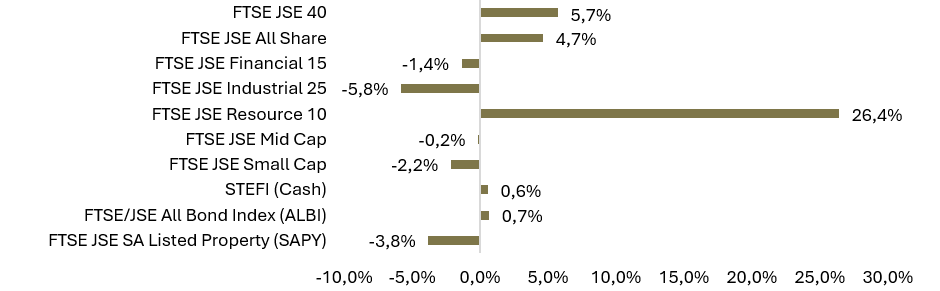
South Africa stood out this month, with the FTSE/JSE All Share Index (ALSI) gaining 4.7% and the Top 40 rising 5.7%, driven almost entirely by gold and platinum miners, who recorded their best month on record. Beyond mining, however, most sectors declined. The rand firmed 2.0% against the dollar to R16.17. July Inflation (CPI) eased to 4.3% from a two-year high of 5.0%.
LOCAL MARKETS
Exhibit 1 | Local Performance (ZAR) for August 2026
South Africa
Economy
South Africa’s inflation slowed in July, with annual consumer prices easing to 4.3% from 5.0% in June, coming in below the 4.5% consensus forecast and the first slowdown in five months. Food and non-alcoholic beverages did much of the work, with the annual rate falling to 0.9% – the lowest reading in more than 16 years, helped by last season’s strong grain harvest. Transport inflation cooled from 12.7% to 8.9% after petrol prices fell 7.1% over the month. Core inflation, which strips out food and energy, edged up to 4.2%.
The Monetary Policy Committee (MPC) did not meet in August, leaving the repo rate at 7.0% and the prime lending rate at 10.5%. The labour market weakened further. Unemployment rose to 33.6% in the second quarter from 32.7%, a four-year high, with youth unemployment reaching 47.4%. Easing headline inflation alongside a deteriorating jobs picture leaves the 23 September decision finely balanced. Forward markets closed August pricing in a roughly 70.0% chance of a 25-basis-point increase.
South African equities had an exceptional month. The ALSI gained 4.7%, and the Top 40 rose 5.7%, but almost all of that came from a single corner of the market.
The Resource 10 index surged 26.4% as gold climbed and the platinum group metals followed. The FTSE/JSE Precious Metals and Mining Index rose roughly 38.0%, its strongest month since the series began in 2006. Most other major sectors lost ground: industrials fell -5.8%, listed property -3.8%, small caps -2.2%, financials -1.4% and mid-caps -0.2%.
Sector performance was sharply divided:
- Gold and platinum producers accounted for the whole of the market’s gain. A softer dollar and receding expectations of higher US rates lifted bullion, and local miners, who earn in dollars and spend in rand, captured that move with leverage.
- Domestically focused shares moved the other way. Food and clothing retailers, consumer staples and the large industrial counters all fell as investors rotated out of the defensive names that had carried the market through the first half of the year.
- South Africa again outpaced its peers, with the ALSI’s 4.7% gain comfortably ahead of the MSCI Emerging Markets Index’s 3.4% rise.
Overall, August was a stark illustration of the divergence between the resource complex and the domestically focused market. Over the past twelve months, the Resource 10 has returned 57.1% while the Industrial 25 has fallen -10.3%, with the ALSI up 18.4% in between.
Best performers:
AngloGold Ashanti: 44.8%
Pan African Resources: 42.5%
Gold Fields: 37.7%
Sibanye Stillwater: 32.9%
Impala Platinum: 25.2%
Worst performers:
British American Tobacco: – 11.1%
Anheuser-Busch InBev: – 10.1%
Clicks Group: – 10.0%
Naspers: – 9.1%
Woolworths : – 8.2%
Bond market and currency
The rand strengthened through August as the gold price climbed and the dollar softened. Foreign investors bought a net R23.1 billion of South African government bonds in the first week of the month, the largest weekly inflow since January. The currency reached R15.93 on 26 August, its strongest print since February, and ended the month at R16.17 against the greenback, R18.74 against the euro and R21.90 against the pound, showcasing gains of 2.0%, 1.5% and 1.4% respectively.
Local bond yields finished close to where they started. The SA 10-year yield fell to 8.47% in the first week of August before backing up to around 8.75% as renewed strikes near the Strait of Hormuz lifted oil and the US Federal Reserve struck a firmer tone at Jackson Hole. The 20-year yield ended near 9.37%.
The All Bond Index (ALBI) returned 0.7% and the Short-Term Fixed Interest Index (STEFI) 0.6%, so bondholders collected little more than their coupon. Real yields remain attractive against global peers, but with core inflation still creeping higher and a fuel price increase from 2 September, the risk of tightening at the 23 September MPC meeting has not gone away.
GLOBAL MARKETS
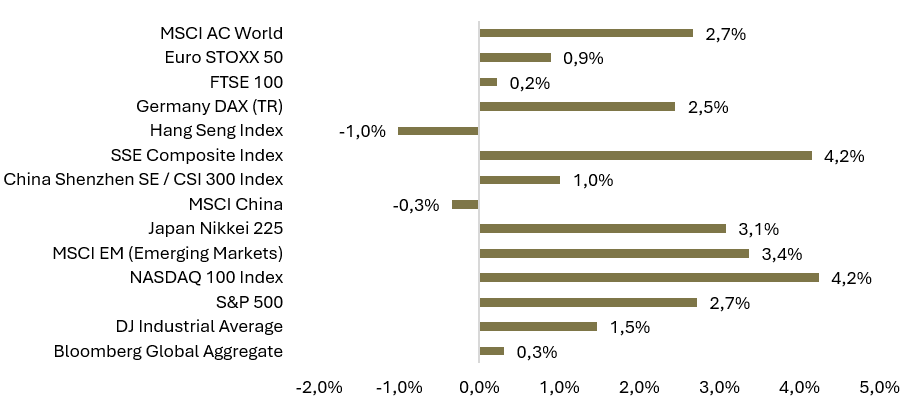
Global markets rose in August as expectations of higher US interest rates receded. A weak July payrolls report, slower consumer price inflation and flat producer prices cut the odds of a September increase from roughly one in two to less than one in three. The dollar fell, precious metals surged, and technology shares reclaimed their lead. The MSCI All Country World Index (MSCI World) gained 2.7%.
Exhibit 2 | Global Performance (base currency) August 2026
Source: Morningstar. Data as at 31 August 2026. Past performance is not indicative of future performance. For illustrative purposes only and not indicative of any investment.
United States
US equity markets recovered July’s losses and more. The US NASDAQ 100 rose 4.2% as investors returned to semiconductor and AI-linked shares, the S&P 500 added 2.7%, and the Dow Jones Industrial Average gained 1.5%. The S&P 500 set an all-time high early in the month before easing back.
Corporate results did much of the work. With nearly all S&P 500 companies having reported, 86.0% beat earnings estimates and second-quarter earnings growth reached 52.0% (the fastest pace since 2021), with all eleven sectors recording higher revenue.
The economic picture was softer. July payrolls fell by 23,000 against expectations of an 83,000 gain, and revisions cut the May and June figures by a further 103,000, although the unemployment rate ticked down to 4.1%. Consumer price inflation eased to 3.4% and core inflation to 2.5%, while second-quarter growth slowed to 1.5% from 2.1%.
The Federal Reserve (Fed) did not meet in August, leaving its policy rate at 3.50% to 3.75%. Speaking at the Jackson Hole symposium, Chair Kevin Warsh said inflation had yet to slow meaningfully and that policymakers needed clearer evidence of easing price pressures.
Bond markets remained unsettled. The Treasury’s decision on 19 August to double its buybacks of 10- to 30-year debt to $4 billion a session pushed the dollar lower and revived questions about the funding of a national debt that has passed $40 trillion. The 10-year Treasury yield ended at 4.75% and the US dollar index at 99.44.
Europe
European equity markets lagged the global recovery. Germany’s DAX Index gained 2.5%, and the Euro STOXX 50 rose 0.9%, held back by the region’s dependence on imported energy as oil moved higher again.
Inflation was the problem. Eurozone consumer prices rose 3.3% in the year to August, up from 2.9% and the highest since September 2023, with energy inflation jumping to 14.3%. The ECB did not meet, but markets ended August fully pricing in a 25-basis-point increase in its deposit rate to 2.5% in September.
United Kingdom
The UK was among the weakest developed markets after leading the field in July, with the UK FTSE 100 flat at 0.2%. The Bank of England (BoE) did not meet, leaving the Bank Rate at 3.75%. Annual inflation rose from 2.6% to 2.9% in July, its first increase since March, driven almost entirely by a 13.0% rise in the regulated cap on household energy bills. The Bank expects it to peak near 3.2% in the fourth quarter.
Asia
Japan was among the stronger markets. The Nikkei 225 rose 3.1%, recovering much of July’s fall, helped by solid corporate earnings and second-quarter growth of about 2.0% annualised. The Bank of Japan left its policy rate at 1.0%, and markets ended August pricing in roughly an 80.0% chance of an increase in September.
China reversed July’s pattern. Mainland markets advanced, with the SSE Composite up 4.2% and the CSI 300 up 1.0%, supported by fresh government measures to lift growth. Offshore shares gave back part of July’s rally, with the Hang Seng Index falling -1.0% and MSCI China -0.3%. New bank lending fell by a record amount in July.
Emerging Markets (EM)
Emerging market equities rebounded, with the MSCI Emerging Markets Index rising 3.4% as the weaker dollar drew money back into the asset class. The index is now up 39.3% over the past twelve months.
Returns were widely dispersed again. Commodity exporters and mainland Chinese shares gained, while Korean and Taiwanese technology shares swung sharply in both directions. South Africa was among the best performers.
Overall, August again reinforced the importance of regional differentiation within emerging markets. Where July rewarded energy exposure, August rewarded precious metals and a weaker dollar.
Commodities
Energy markets stayed tight. Brent Crude Oil rose roughly 3.0% to end August at around $91/bbl, having traded above $95 in the second half of the month as US strikes near the Strait of Hormuz continued and shipping remained disrupted.
Precious metals were the story of the month. Gold rose roughly 9.0% to end August at approximately $4,450/oz (its strongest month since January) after trading above $4,600 mid-month. Central banks bought a record 288.9 tonnes in the second quarter.
Silver rose about 15.0% to around $67/oz and platinum roughly 8.0% to about $1,790/oz, both supporting South African producers. Copper closed at $14,285 a tonne, 3.5% higher, on falling exchange inventories and a Congolese ban on concentrate exports.
Outlook
August turned July’s narrative on its head. The energy shock has not gone away, but for one month the dominant force was a softer United States economy and the market’s conclusion that the Fed has less room to tighten than it had thought.
September is unusually dense. The Fed meets on 15 and 16 September, the BoE on 17 September and the SARB on 23 September, with the ECB and the Bank of Japan also due. Markets have them pointing in different directions: a European increase is fully priced, a Japanese one close to it, and the Fed expected to hold. Shipping through the Strait of Hormuz could unsettle all of them.
For South Africa, the 23 September MPC meeting is another close call. Headline inflation has fallen back to 4.3%, which argues for patience, but core inflation is still creeping up, unemployment sits at a four-year high, and another fuel price increase took effect on 2 September. Forward markets still lean towards an increase.
The JSE’s commodity weighting remains the swing factor for local returns, and August showed just how powerful it can be. One sector delivered the whole of the market’s gain while everything else fell. The same leverage that produced a 26.0% gain in resources can reverse quickly if the gold price consolidates. Local valuations still sit at a discount to emerging market peers.
In this environment, maintaining broad diversification across asset classes and regions remains essential. Quality, resilience and disciplined portfolio construction continue to be the most effective tools for navigating what remains an uncertain and event-driven market backdrop.

