

A sharp sell-off in technology shares and another rise in oil prices drove global markets lower in October. Doubts over whether heavy spending on artificial intelligence (AI) will pay off hit chipmakers, pulling the US NASDAQ 100 and most Asian markets lower. Brent crude rose about 14% as attacks on shipping around the Strait of Hormuz increased. The US Federal Reserve (Fed), the European Central Bank (ECB) and the Bank of Japan all held rates steady, and investors moved into government bonds. Gold, silver and platinum fell to their lowest levels in about a year, which hurt South African miners.
South African markets held up far better than other emerging markets. The FTSE/JSE All Share Index (ALSI) slipped -0.4% and the Top 40 -1.0%, as gains in financial, industrial and mid-cap shares made up for a -9.1% fall in resources. The rand weakened about -1.7% against the dollar to around R16.71, while local bonds rallied after the Medium-Term Budget Policy Statement (MTBPS) was well received. The South African Reserve Bank (SARB) did not meet, so the repo rate stayed at 7.25%.
LOCAL MARKETS
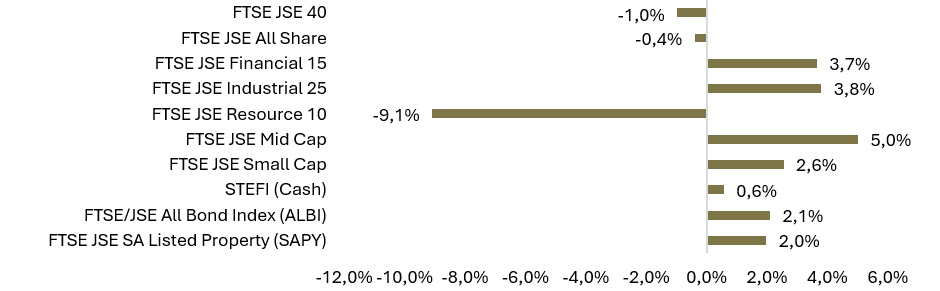
Exhibit 1 | Local Performance (ZAR) for October 2026
South Africa
Economy
South Africa’s inflation rose for a second month in September, from 4.4% to 4.5%, below the 4.7% consensus forecast. Transport was again the main source of pressure at 10.8%. Housing and utilities rose 5.2%, with electricity and other fuels up 7.7%, and food and non-alcoholic beverages ticked up from 1.1% to 1.2%. Core inflation, which strips out food and energy, eased from 4.1% to 4.0%, so the fuel shock has not yet spread widely to other prices.
Finance Minister Enoch Godongwana presented the MTBPS on 21 October. Treasury cut its 2026 growth forecast from 1.6% to 1.2%, but stronger tax collections narrowed the expected budget deficit to 3.9% of GDP, and government debt peaked at 78.4% of GDP last year. After pump prices hit record highs in October, government also announced temporary fuel levy relief of R1.50 a litre on petrol and R3 a litre on diesel from 4 November.
South African equities were broadly flat, with the ALSI down -0.4% and the Top 40 -1.0%.
The Resource 10 index fell -9.1% as precious metal prices slumped. Returns elsewhere were positive: financials gained 3.7%, industrials 3.8%, mid-caps 5.0%, small caps 2.6% and listed property 2.0%.
Sector performance was mixed:
- Platinum and gold miners led the declines. Expectations of higher-for-longer interest rates and forced selling during the technology sell-off pulled precious metal prices sharply lower.
- Energy and offshore earners led the gains. Sasol benefited from higher oil prices, and rand hedges, including global consumer goods and telecommunications groups, gained as the rand weakened. Banks and insurers rose as bond yields fell.
- South Africa outperformed its peers by a wide margin, with the ALSI’s -0.4% dip well ahead of the MSCI Emerging Markets Index’s -8.1% decline.
The Resource 10 has now fallen for two months in a row, by -9.8% in September and -9.1% in October. Over the past twelve months, it has still returned 6.4% and the Financial 15 18.2%, while the Industrial 25 has fallen -14.7%, leaving the ALSI up 2.5%.
Best performers:
Sasol 26.3%
British American Tobacco 15.7%
MTN Group 11.6%
Anheuser-Busch InBev 9.3%
Old Mutual 8.7%
Worst performers:
Impala Platinum -16.6%
Valterra Platinum -16.2%
Sibanye-Stillwater -15.7%
Northam Platinum -13.2%
Harmony Gold -13.0%
Bond market and currency
The rand weakened in October as precious metals fell and oil climbed, though it recovered some ground after the MTBPS. It traded between roughly R16.34 and R16.75 against the dollar and ended the month at around R16.71, down about -1.7%. Against the euro, there was little change at around R18.65, but it lost about -2.7% against the pound to R22.38 as sterling firmed on expectations of a Bank of England (BoE) rate increase.
The SA 10-year yield started the month above 9.0% and dropped after the MTBPS to end near 8.73%, while the 20-year yield ended near 9.2%. Lower US Treasury yields helped, as did the better fiscal outlook and an inflation print below forecasts.
The All-Bond Index (ALBI) returned 2.1% and the Short-Term Fixed Interest Index (STEFI) 0.6%, so bonds comfortably outperformed cash. Record fuel prices are likely to lift October inflation, which will keep bonds sensitive to oil and the rand ahead of the SARB’s 19 November Monetary Policy Committee (MPC) meeting.
GLOBAL MARKETS
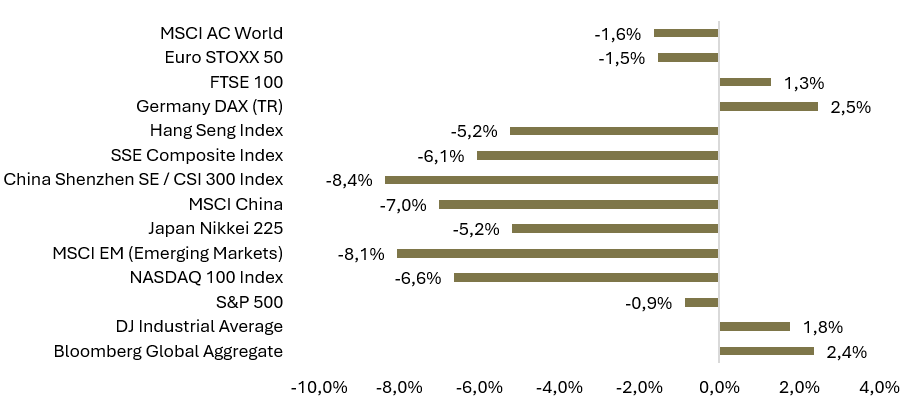
Global markets fell in October as the sell-off in AI-linked shares spread from the US to Asia, where chipmakers in Korea, Taiwan and Japan were among the hardest hit. Investors moved into government bonds, while higher oil prices kept inflation in focus. The MSCI All Country World Index (MSCI World) lost -1.6%.
Exhibit 2 | Global Performance (base currency) October 2026
Source: Morningstar. Data as at 31 October 2026. Past performance is not indicative of future performance. For illustrative purposes only and not indicative of any investment.
United States
US equity markets were sharply divided. The US NASDAQ 100 fell -6.6% after disappointing results and heavy spending plans from large technology companies hit AI-linked shares, semiconductors in particular. The S&P 500 slipped only
-0.9% and the Dow Jones Industrial Average rose 1.8%, as nine of the 11 S&P 500 sectors gained and investors moved into healthcare, consumer, energy and value shares.
The economy grew at an annualised 3.4% in the third quarter, up from 2.2%, led by consumer spending and AI-related investment. Inflation rose from 3.4% to 3.7% in September, with energy prices up more than 20%, and core inflation rose to 2.6%. Unemployment edged up to 4.2%.
The Fed held its policy rate at a target range of 3.75% to 4.00% on 28 October. Two members voted to raise it, and markets predict a strong chance of an increase at the next meeting on 9 December.
Bond markets rallied. The 10-year Treasury yield touched about 5.36% early in the month (its highest since 2002), then fell to end near 4.93%, its largest monthly drop since 2023. The US dollar index rose about 0.3% to around 101.8, while the euro fell about -1.2% to around $1.12.
Europe
European equity markets were mixed. Germany’s DAX Index gained 2.5%, and the broader European market had its best month since June, helped by energy, defence and bank shares. The Euro STOXX 50 lost -1.5% as its large technology companies followed US chip stocks lower and worries about France’s public finances pushed French bond yields up.
The ECB kept its deposit rate at 2.50% on 29 October and warned that energy prices could push inflation higher. Markets still expect an increase in December. Eurozone inflation rose from 3.2% to 3.8% in September, its highest since 2023. ECB President Christine Lagarde also announced she will step down in February 2027, eight months before her term ends.
United Kingdom
The UK FTSE 100 rose 1.3%, supported by its large energy companies. Annual inflation rose from 3.1% to 3.5% in September on higher fuel prices, and markets widely expect the BoE to raise the Bank Rate from 3.75% at its 5 November meeting, its first increase since 2023.
Asia
The Nikkei 225 climbed above 70,000 early in the month but ended October down -5.2% as chip and AI-related shares sold off. The Bank of Japan kept its policy rate at 1.25%, with one member voting for an increase, and said it will continue to raise rates.
Chinese markets fell sharply. The CSI 300 lost -8.4%, its steepest monthly decline since early 2016, after a record twelve consecutive weekly falls left it more than 20% below its June peak. The SSE Composite fell -6.1%, the Hang Seng Index -5.2% and MSCI China -7.0%. The economy grew a better-than-expected 4.5% in the third quarter, which reduced hopes of further stimulus, and weak company profits and soft consumer spending added to the pressure.
Emerging Markets (EM)
The MSCI Emerging Markets Index fell -8.1% as the sell-off in chipmakers hit Korea and Taiwan, two of its largest markets, although it is still up 14.1% over the past twelve months.
Returns were widely dispersed. Indonesian equities had their worst month in about 18 years after index provider MSCI warned it could downgrade the market, and mainland China entered a bear market. South Africa was among the strongest performers.
The technology exposure that helped Asian markets in September hurt them in October, while markets with a broader spread of sectors held up better.
Commodities
Energy markets tightened further. Brent Crude Oil rose roughly 13.6% to end October at around $117 a barrel, its highest level since late April and its fourth monthly gain in a row. At least 35 attacks on shipping were reported in the Gulf and the Strait of Hormuz during the month. Higher oil prices are feeding into inflation forecasts in most major economies.
Precious metals fell sharply. Gold dropped roughly -7.2% to around $3,880/oz, its lowest level in a year and its worst October since 2008, as expectations that interest rates will stay high reduced the appeal of a metal that pays no income. It is now about 30% below its January record.
Silver fell about -19.2% to around $49/oz, and platinum fell roughly -16.7% to about $1,430/oz, a 13-month low, which weighed heavily on South African producers. Copper slipped about -1.8% to around $14,140 a tonne, its first monthly fall since June.
Outlook
Doubts about AI spending hit the large technology shares that now make up a big part of US indices, and oil above $110 a barrel is keeping pressure on inflation and interest rates.
The US holds midterm elections on 3 November, the BoE is expected to raise rates on 5 November, and the Fed meets again on 9 December. The Strait of Hormuz remains the single biggest swing factor for oil and, through oil, for inflation and interest rates.
For South Africa, local government elections take place on 4 November, and the next MPC announcement is on 19 November. Record fuel prices are likely to push October inflation higher, although the fuel levy relief should ease the pressure until early January. The MTBPS improved the fiscal outlook, but growth remains weak.
Commodity prices continue to drive much of the JSE’s return. In October, the rest of the market made up for the fall in resources. Local valuations are still at a discount to emerging market peers.
In this environment, maintaining broad diversification across asset classes and regions remains essential. Quality, resilience and disciplined portfolio construction continue to be the most effective tools for navigating what remains an uncertain and event-driven market backdrop.

